Your Business Maturity Hub Help Centre
Back to Learning Centre

Your Business Maturity Hub

Assess your organisation across 10 key business categories, understand what the results mean, and turn priorities into measurable improvement.
Use this guide to learn how each part of the hub helps your team assess, align, prioritise and improve.

Business maturity dashboard illustration

Assess

Complete assessments across all 10 categories

Understand

Learn through courses and interpret your results

Prioritise

Assign owners and agree what matters most

Improve

Track progress, benchmark and reassess

How the Business Maturity Hub Works

Each section below links to the matching step-by-step guide and video chapter.

1

Operational Dashboard

See maturity, priorities, objectives and risks across the whole organisation from one view.
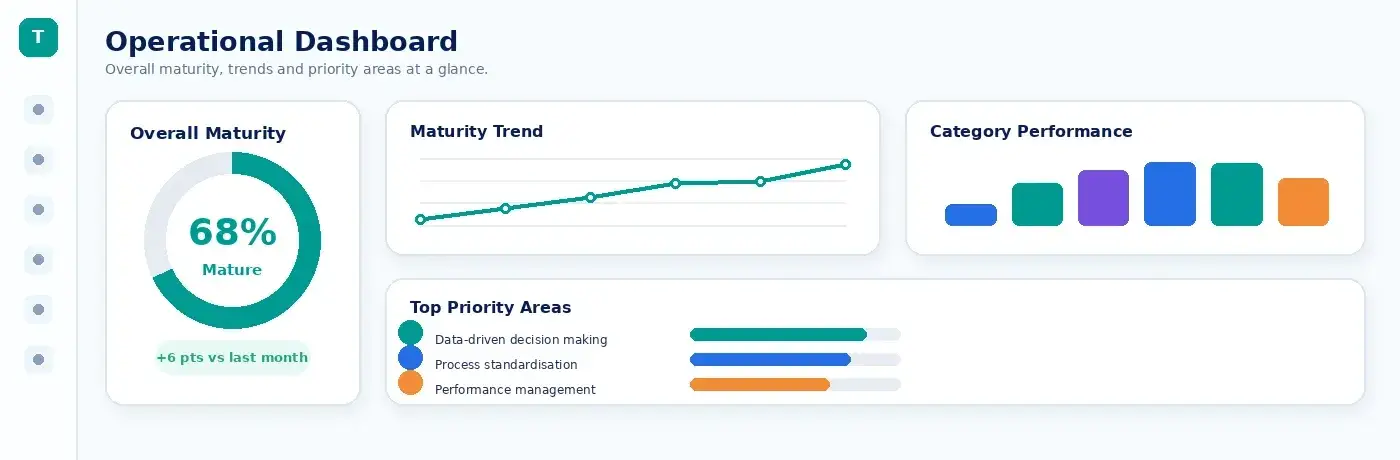
Operational Dashboard preview
Organisation-wide maturity, objectives and at-risk issues
CEO and manager views across teams, owners and priorities
Frontline views limited to each person’s assigned work
2

Business Maturity Hub

Assess maturity across 10 categories. Assign owners and monitor progress over time.
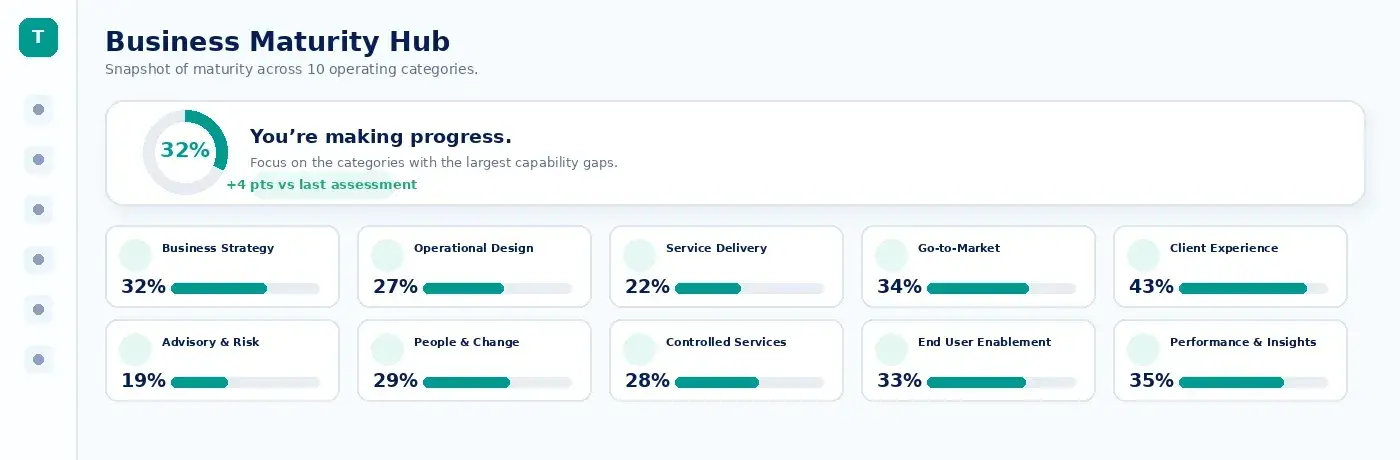
Business Maturity Hub preview
Complete assessments and category courses
Track scores, trends and assigned category owners
Benchmark performance and reassess over time
3

Category Pages

Deep-dive into each category. Understand results, gaps and specific improvements.
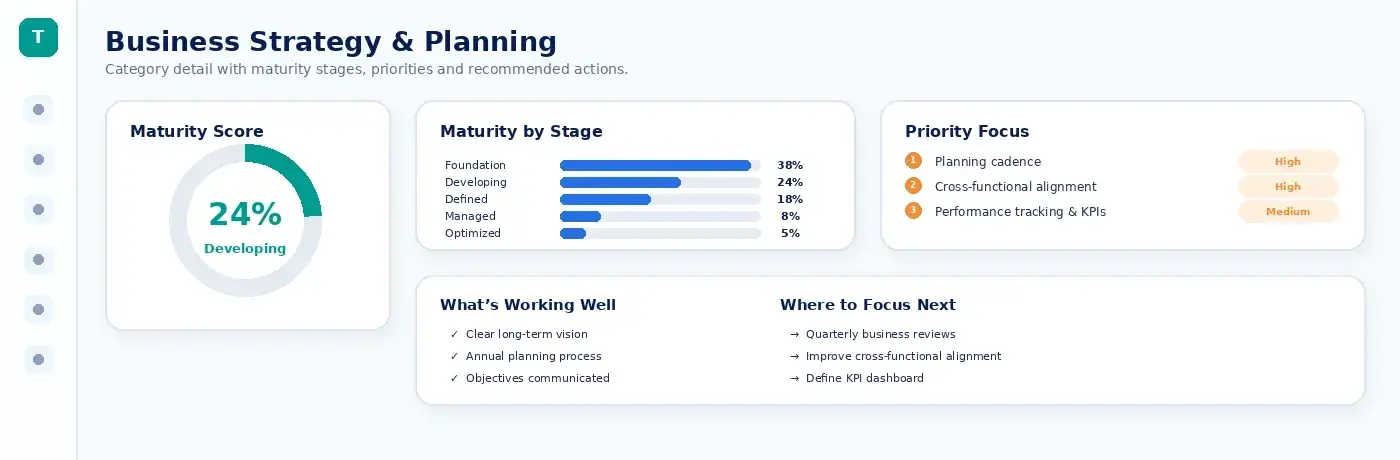
Category Pages preview
Explore category and subcategory performance
Understand strengths, gaps and recommended focus areas
Select the actions and resources that matter most
4

Full-View Growth Roadmap

Bring every priority onto one page. Sequence work across the organisation.
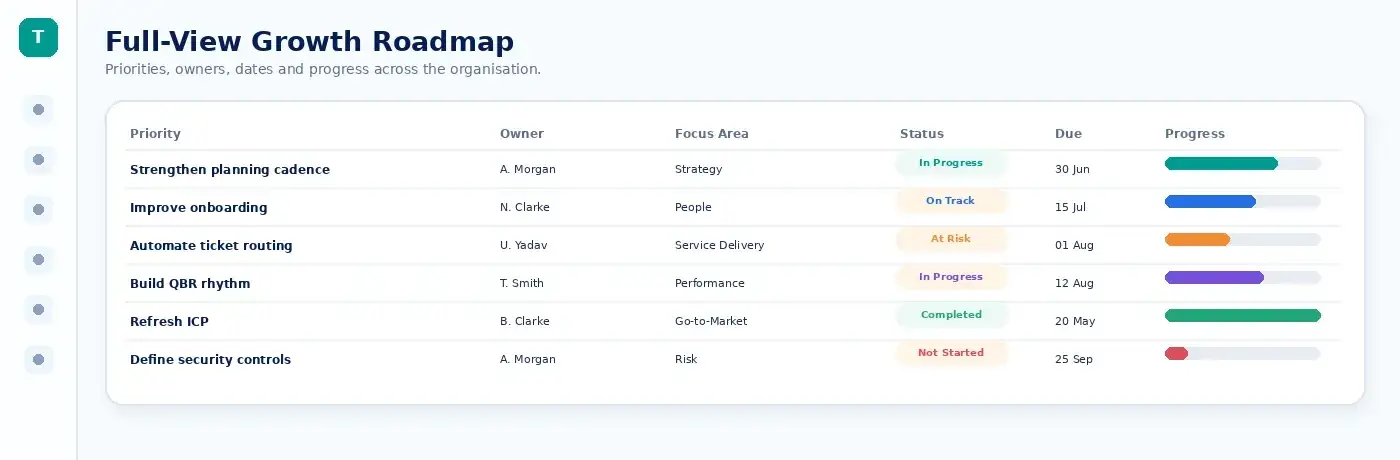
Full-View Growth Roadmap preview
View all roadmap actions in one place
Prioritise across categories, owners and timelines
Track progress and keep the organisation aligned

Get the Most from the Business Maturity Hub

Watch the short overview, then use the Step-by-Step Guide to open the right section and video whenever you need help.

Operational Dashboard

See the health of your organisation in one place, with visibility tailored to each person’s role.

Business Maturity Hub walkthrough
▶00:00

What you’ll see

  • A single view of business maturity, strategic confidence and organisational progress.
  • Objectives, actions and issues that are on track, due or at risk.
  • Role-based information relevant to you—leaders see organisation-wide performance, while team members see their assigned responsibilities.

How to use this page

  • Review the overall health of the business and identify areas requiring attention.
  • Check progress across teams, objectives and individual accountabilities.
  • Select an item to investigate the issue, owner, due date and required next step.
Start with the whole-business view

Use the dashboard to identify where attention is needed, then open the relevant hub, objective or owner to take action.

Business Maturity Hub

Complete assessments, understand the results, assign accountability and measure maturity improvement.

Business Maturity Hub walkthrough
▶02:15

What you’ll see

  • Maturity assessments covering each of the 10 TPOS business categories.
  • Courses that explain each category and what stronger maturity looks like.
  • Current results, assigned category owners, progress over time and available benchmarking.

How to use this page

  • Complete the assessments to establish your current maturity baseline.
  • Review the results with your leadership team and identify priority categories.
  • Assign ownership, revisit results regularly and reassess to measure improvement.
Establish the baseline first

Complete enough of the assessment to understand the current state before setting targets or choosing improvement priorities.

Category Pages

Use Category Pages to understand the detail behind a maturity result and choose the right improvement area.

Business Maturity Hub walkthrough
▶05:30

What you’ll see

  • A detailed view of one business category and its supporting subcategories.
  • Your maturity results, gaps and potential areas for improvement.
  • Relevant growth roadmaps, guidance and supporting resources.

How to use this page

  • Explore the category to understand where the business is performing well or falling behind.
  • Select the specific subcategories that need improvement.
  • Choose the most relevant growth roadmap and assign responsibility for the next steps.
Move from category to specific action

Use the subcategory detail to avoid broad improvement efforts and focus on the few actions that will create the strongest uplift.

Full-View Growth Roadmap

Use the full-view roadmap to see every selected improvement priority across the organisation in one place.

Business Maturity Hub walkthrough
▶08:45

What you’ll see

  • Every selected growth priority across the organisation in one consolidated view.
  • The category, priority, owner, current status and next action for each improvement area.
  • A clear picture of what is planned, underway, completed or at risk.

How to use this page

  • Compare priorities across the business before committing time and resources.
  • Agree which improvements should happen now, next or later.
  • Assign clear ownership, track progress and use the roadmap during leadership reviews and planning meetings.
Sequence the improvement portfolio

Use one consolidated roadmap to prevent too many improvement initiatives competing for the same people and resources.

Next: Business Maturity Hub

Common Questions

Where should we start?

Complete the maturity assessments to establish a baseline, then use the results to identify the categories requiring attention.

Who should own each category?

Assign one accountable owner who can coordinate improvement activity and report progress to the leadership team.

How often should we reassess maturity?

Reassess after meaningful improvement work or at an agreed leadership cadence so you can measure evidence-based uplift.

Explore the 10 Key Category Areas

Use the maturity assessment to understand performance across each operating area, assign ownership and focus improvement where it matters most.

01
Business Strategy & PlanningDirection, planning, performance management and strategic focus.
02
Organisational Design, People & HRStructure, accountability, roles, leadership and people systems.
03
Finance, Commercials & AdministrationFinancial control, commercial decisions and administration.
04
Solution ProductionHow products, services and repeatable solutions are designed.
05
Go-to-Market & Demand GenerationDemand, marketing, sales positioning and acquisition.
06
Client Experience & SuccessOnboarding, experience, retention and customer success.
07
Advisory, Governance, Risk & ComplianceGovernance, advisory, risk management and compliance.
08
Project & Change ServicesProject delivery, change management and delivery governance.
09
Scalable Centralised ServicesShared services, standardisation, automation and scalability.
10
End User Enablement & SupportSupport, knowledge, training, adoption and user experience.